



-

Micro LSR Seal Design: Flash Prevention Tips for Precision Molding
-
Advantages of Liquid Silicone Rubber (LSR): Why It Is Replacing Traditional Rubber and Plastics
-
LSR Injection Molding (Cold Runner) vs. Compression Molding LSR (Runnerless): Process & Selection Guide
-
Medical Injection Molding DFM Checklist & Design Guidelines
Clean Room Injection Molding: Defect Prevention
2026-07-10




复制成功
Clean room injection molding is a high-precision manufacturing process essential for producing contamination-free plastic parts used in medical device, pharmaceutical, and high-end electronic applications.
Even with rigorous workshop management, clean room molding is uniquely susceptible to subtle defects. Left unchecked, these flaws lead to high scrap rates, compliance failures, and costly production delays.
This guide outlines the most common clean room injection molding defects, analyzes their root causes, and provides actionable prevention strategies to stabilize your production and meet strict industry certification standards.
What Makes clean room injection molding Defects Different?
In standard injection molding, minor cosmetic variations or microscopic particles are often acceptable as long as dimensional tolerances are met. In a clean room environment, cleanliness overrides everything—zero contamination is the baseline.
Clean rooms typically operate under strict ISO 7 (Class 10,000) or ISO 8 (Class 100,000) standards to control airborne particles, humidity, and human interference. Consequently, most defects do not stem from basic machine parameter errors. Instead, they are triggered by environmental pollution, non-standard operations, or improper post-processing.
| Defect Type | Primary Root Cause | Impact on Clean Room Standards |
| 1. Surface Particles & Black Spots | Unclean raw materials, mold carbon deposits, or airborne dust. | Instantly fails cleanliness tests; top cause of product scrap. |
| 2. Short Shots (Incomplete Filling) | Altered material viscosity due to fixed clean room humidity/temp. | Compromises structural integrity and dimensional compliance. |
| 3. Flash & Burr Residues | Mold wear or excessive injection pressure. | Burrs can flake off, generating secondary micro-particle pollution. |
| 4. Warpage & Deformation | Mismatched cooling cycles against constant room ambient temperatures. | Causes structural distortion in high-precision PEEK/LSR components. |
| 5. Bubbles & Vacuum Voids | Moisture absorption in resins or inadequate material degassing. | Invisible flaws that cause regulatory (FDA/ISO) audit failures. |
Quick Reference: Common Defects, Root Causes & Prevention
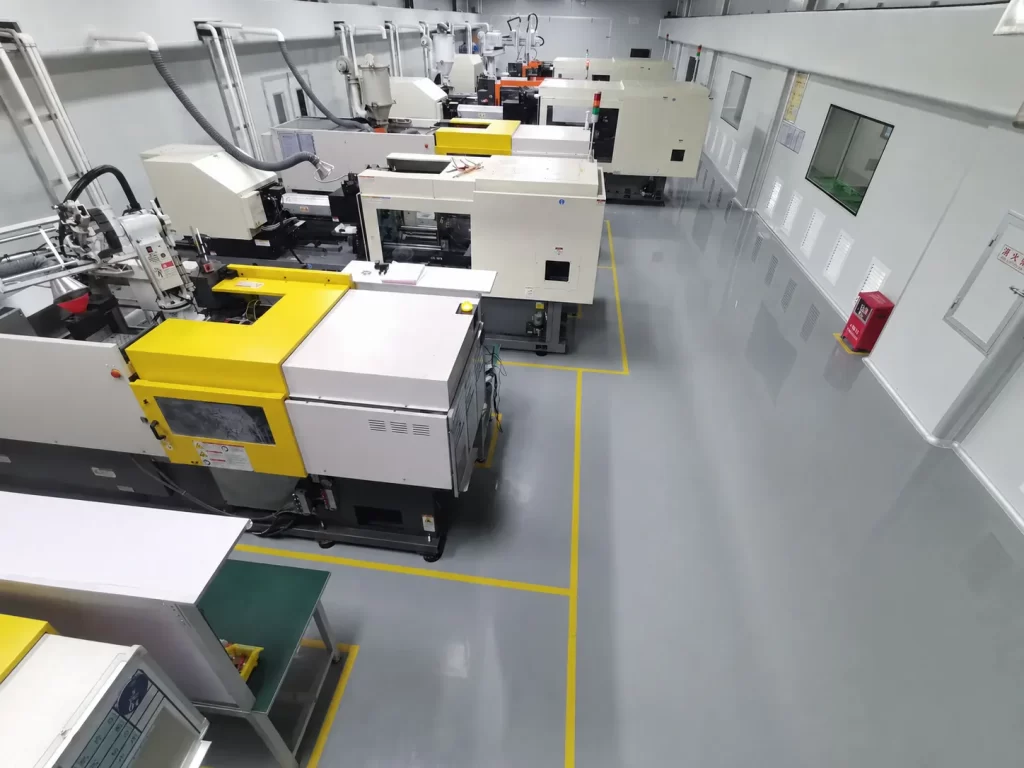
Deep Dive: 5 Critical Defects & Core Causes
1. Surface Particle Contamination & Black Spots
Tiny dust particles, fiber debris, or carbon spots on the part surface will immediately disqualify a batch during quality inspections.
The Cause: Improperly sealed raw materials (like medical-grade PEEK or LSR), unfiltered air intake, excessive staff movement, or residual release agents left inside the mold cavity.
2. Short Shots & Incomplete Filling
Because clean rooms maintain a highly controlled, fixed environment, material behavior can shift unexpectedly.
The Cause: Fluctuations in clean room temperature and humidity can alter melt fluidity. This is compounded by insufficient injection pressure or poor mold venting that traps air inside the cavity.
3. Flash & Burr Residues
While minor flash is a cosmetic nuisance in commercial molding, it is a critical failure in medical manufacturing.
The Cause: Long-term clean room production without standardized mold maintenance leads to minor mold wear. High melt temperatures or excessive injection pressures force material into these microscopic gaps.
Critical Risk: Micro-burrs on medical parts can easily detach during post-processing or assembly, introducing dangerous particulate contamination into sterile environments.
4. Warpage & Dimensional Instability
High-precision medical and electronic parts demand tight dimensional stability.
The Cause: Standard cooling adjustments are often restricted by fixed clean room ambient temperatures. Uneven part wall thickness or internal stress release in specialized materials (like LSR) frequently leads to warping.
5. Bubbles & Vacuum Voids
These hidden defects typically occur in thick-walled sections of the molded part.The Cause: Resins absorbing moisture under constant clean room humidity, or inadequate material degassing prior to injection.
Actionable Prevention Tips for Stable Production
1. Maintain Strict Environmental Controls
To uphold ISO 7/ISO 8 compliance, keep air purification systems running optimally, restrict personnel access, and enforce strict sterile gowning protocols. Regularly sanitize all equipment and tools to eliminate floating particulate matter.
2. Standardize Raw Material Management
Store all medical-grade resins in sealed, temperature-controlled, dust-free containers. Implement thorough pre-production drying and dehumidification cycles to eliminate moisture-induced bubbles. Never mix virgin and regrind materials for clean room projects.
3. Optimize Mold Maintenance & Venting
Establish a rigorous, non-contaminating mold maintenance schedule. Clean and polish cavities regularly to remove carbon deposits. Optimize the mold’s exhaust system to eliminate air traps, effectively preventing both short shots and flash.
4. Calibrate Parameters to the Clean Room Climate
Incorporate the ambient clean room temperature and humidity into your molding parameter baselines. Fine-tune injection pressure, speed, and holding times specifically for the unique rheological behaviors of high-purity materials like PEEK and LSR.
5. Enforce Sterile Post-Processing & Packaging
All gate cutting, inspection, and packaging must occur inside the clean room. Operators must use sterile, dust-free tools and wear specialized gloves. Final parts should be immediately enclosed in vacuum-sealed sterile packaging to isolate them from external contamination.
Partner with an ISO 13485 Certified Expert
Achieving defect-free clean room injection molding requires an experienced partner with an airtight quality management system.
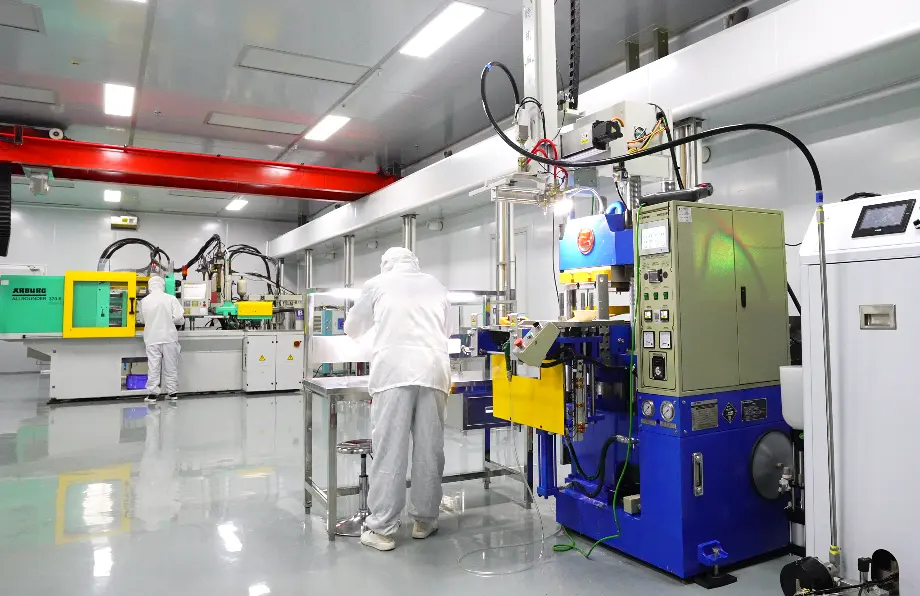
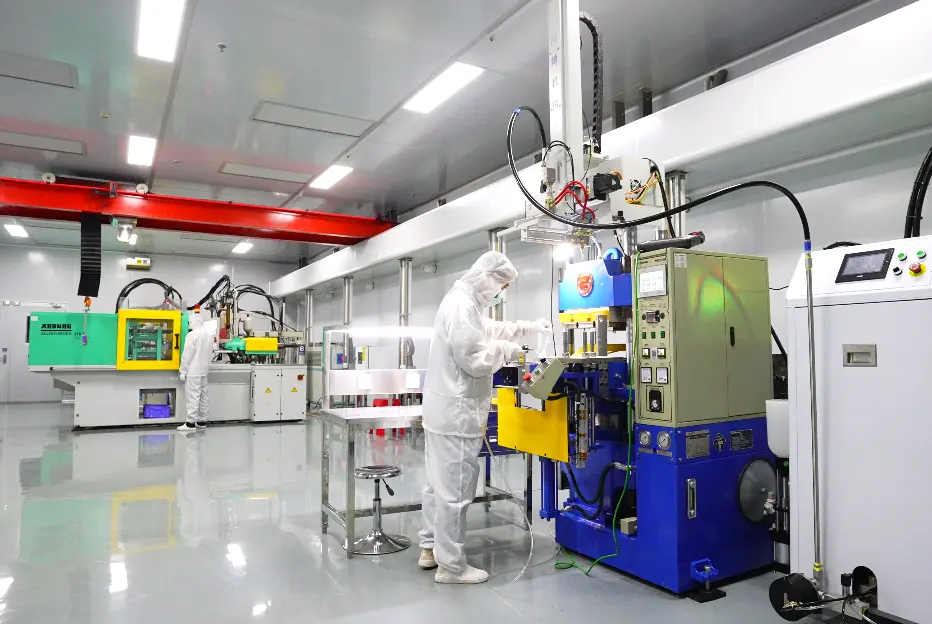
At Dongguan Yize Mould Co., Ltd., we operate a state-of-the-art Class 1000 (ISO 6/7 equivalent) cleanroom designed to safely and reliably manufacture high-precision components that meet the world's most stringent standards. Backed by our ISO 13485 certification, we provide full traceability and strict quality control for medical and electronic applications.
Explore Our Capabilities: [Link to Homepage] | [Link to Product Cases]
Get a Professional DFM Analysis: Send us your project drawings today for a comprehensive quality and manufacturing evaluation.
Contact Our Engineering Team:
Email: Yuliya.chen@yizemould.com
Telephone / WhatsApp: +86 13342659272
FAQ
Q1: What causes particle spots in clean room injection molding?
A: Impure raw materials, polluted cleanroom injection molding workshop, mold carbon deposits and secondary packaging contamination are the main triggers of particle defects in clean room molding.
Q2: How to avoid flash and burrs during clean room injection molding?
A: Do regular mold maintenance, adjust injection parameters reasonably and reduce long-term wear in cleanroom injection molding to prevent burr issues of clean room molding parts.
Q3: Why warpage easily occurs in clean room injection molding products?
A: Constant temperature and humidity in the workshop, special materials like PEEK and unreasonable wall thickness will lead to deformation problems for cleanroom injection molding and clean room molding components.
Q4: What standards should a qualified clean room injection molding factory meet?
A: Reliable suppliers need ISO7/ISO8 clean workshop, ISO13485 certification and full contamination control solutions for cleanroom injection molding and clean room molding projects.
Q5: Can all defects of clean room injection molding be completely prevented? A: Most common flaws in cleanroom injection molding and clean room molding can be eliminated via standardized environment, material, mold and QC management.